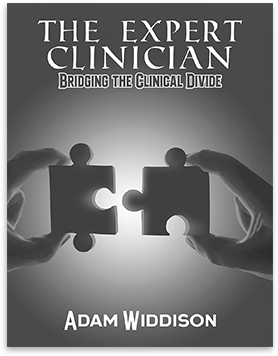
How did "The Expert Clinician" take shape?
I first started putting "pen to paper" in 2015
when I was teaching students and trainees and actively involved in managing
education and training. The project was born out of a concern that many of my
colleagues and I had, which was that the perceived value of the consultation
among many trainees had declined. As trainers and educators, we did our best to
emphasise the importance and relevance of the consultation, but to little
effect. More often than not, it seemed that trainees were "taking a
history and examining the patient" to fill in a proforma rather than to
try to help the patient. It was obvious to all that experienced clinicians no
longer relied on the trainees' written medical records: they preferred to learn
the information for themselves. I, therefore, wondered what was wrong with
current training and what could be done to restore the value of the
consultation among medical trainees.
I knew what I wanted to achieve but was uncertain how to
bring about change. After all, who was I to say that there was a problem and
change was needed? I knew I would not be able to do a clinical trial and was
highly skeptical that journals would publish my opinion. Therefore, I felt a
book would be needed.
Initially, I wrote about the physiology, anatomy, and
pathology of the different organs and systems, describing how problems present
and are managed. However, these initial thoughts simply replicated traditional
practice and could not address the concerns. Nevertheless, through writing and
reflecting, ideas began to crystalise about what was wrong with the standard
approach and what to do about it.
Trainees are taught the basic sciences, pathology, and how
the different problems may present and be managed. They are also taught
reasoning skills so that they can apply this knowledge in clinical practice.
The difficulty faced is that they have to reverse their learning. I therefore
thought that I was approaching the problem the wrong way round: how can I help
trainees use the symptoms and signs to determine the underlying abnormality?
However, this created a new problem: how to explain the pathogenesis of the
many different presenting symptoms. While thinking about how to write this, I
realised that I did not need to explain each and every symptom because
patients' problems fall into one or more of four problem categories: pain(s),
deranged function, such as breathlessness, feeling ill, or an external
abnormality, later to become a visible or palpable abnormality. I only needed
to describe the principles for each. The emphasis should be on learning to
understand and using a knowledge of medicine and the basic sciences to know
what questions to ask or signs to look for and to understand and interpret the
available information. These now became the main chapter headings for my first
proper draft.
Over the next few years, I researched and wrote in detail
about each topic, explaining the principles of how to clinically determine the
underlying abnormality from the symptoms and signs. I used teaching
opportunities to test these ideas out and to refine the details and method.
However, as the chapters were completed, it became apparent that there was a
lot of repetition and the focus was on formulating a diagnosis. On reflection,
this seemed to be incomplete. Consultations are undertaken for many different
reasons and not just to formulate a diagnosis. For example, some are undertaken
to share information with the patient, such as the results of a test; some to
deal with concerns from an aggrieved patient; and others to discuss management
options. A different approach was needed for each consultation. As I thought
more about this and critically thought about my own practice and watched
others, I realised that we used the context of the consultation and first
impressions to determine the aims and then ensured questions were asked and
signs sought to ensure the outcome met the aims. In other words, meeting the
aims of the consultation was more important than applying a proscribed history
and examination format. While thinking about the many different aims, I
realised there were essentially four core aims and these apply to all
consultations to a greater or lesser extent. The core aims were to exchange
information, to establish a working relationship, to formulate a diagnosis, and
to plan management. Sometimes information exchange or establishing a working
relationship were the principal aims, but more often they were enablers: they
enabled the clinician to formulate a diagnosis and plan management. This led to
the book being completely reorganised and re-written so that the methods
available to meet each of the aims were brought together as four separate
chapters.
I now had to decide how to describe the application of the
method in clinical practice. As I thought more about the consultation and
watched other clinicians, I realised that there were three distinct parts to
the consultation: the start, the body, and the concluding conversation. I,
therefore, wrote the first chapter in this section to describe how experienced
clinicians use the start of the consultation to confirm information, such as
the patient details and the context of the consultation, to help the patient
relax, to assess the patient, and to determine the aims and decide on the
initial focus of the consultation. The detail of how to learn and understand
information about the Person, the Patient, and the Problem and from the
Examination to ensure the outcome meets the aims is described in the next four
chapters. The final chapter describes how to conclude the consultation so that
the patient is left informed and happy, knowing that they are being helped. The
layout of this section of the book now mirrored the format used by experienced
clinicians during the consultation.
The final layout of the book only took shape after I retired
in 2021 when I had the time to concentrate on writing the book and to ensure
the style and format were consistent. It has been a long journey, with many
revisions and rewrites, and at times I did not think it would ever get
finished. I found it particularly difficult to think "outside the
box": there was always a tendency to return to traditional practice and
thinking. I also found it difficult to describe some concepts, such as "learning
to understand, determining the location of the abnormality, and the type of
problem," and struggled to find a way to emphasise the importance of
focusing on meeting the aims, i.e., knowing why you are asking a question or
performing an examination, rather than defaulting to routine.
Post Views : 4